USML Hosts Interfaith Dialogue on Human Dignity at Shrine of Our Lady of Guadalupe
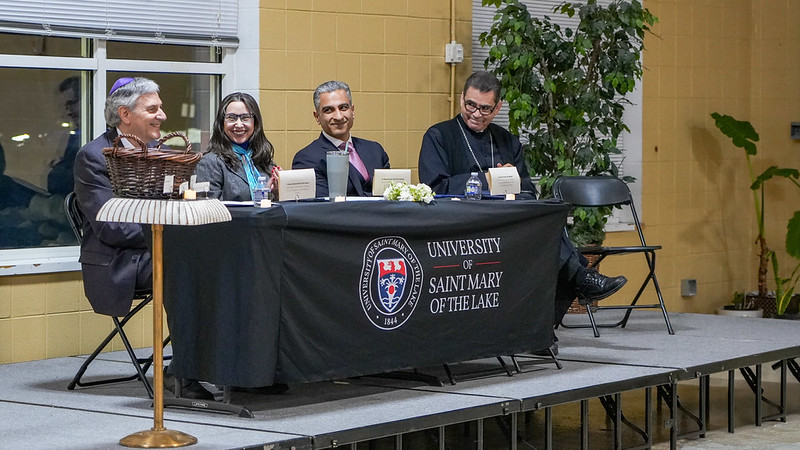
On Thursday, December 4, the University of Saint Mary of the Lake’s School of Parish Leadership and Evangelization hosted the “Interfaith Prayer for Human Dignity | Oración interreligiosa sobre la dignidad humana” at the Shrine of Our Lady of Guadalupe’s Tepeyac Pastoral Center.
The program centered on prayer, reflection, and dialogue concerning the inherent dignity of the human person, featuring panelists from Catholic, Jewish, and Muslim traditions. The Very Rev. Esequiel Sanchez, rector of the Shrine of Our Lady of Guadalupe for the Archdiocese of Chicago, attended and offered a brief prayer and remarks to the assembly.
Panelists included:
- Dr. Melanie Barrett, PhD, STD, serves as Professor of Moral Theology at the University of St. Mary of the Lake/Mundelein Seminary.
- Professor Bernie Newman, MS, is a Jewish Gabbai (Deacon), Past President of Congregation Beth Shalom Naperville, and Instructor at Benedictine University.
- Dr. Syed A. Rizwan, PhD, is an Assistant Professor of Islamic and Interreligious Studies and Director of Catholic-Muslim Studies at Catholic Theological Union, Chicago.
The discussion emphasized a shared commitment to the core values of compassion, justice, and peace, which transcend religious boundaries. Panelists addressed how their faith traditions call on adherents to uphold and defend human dignity in all circumstances.
The event was coordinated by Dr. Rita George Tvrtkovic, dean and professor at the School of Parish Leadership and Evangelization. George Tvrtkovic has served as a consultor for the Vatican’s Dicastery for Interreligious Dialogue, advising the Holy See on relationships with non-Christian faiths and drawing on her expertise in Christian-Muslim dialogue.
The event underscored the school’s commitment to dialogue with the Church and the world, as future leaders will encounter people from a range of backgrounds in their ministries — from fellow Catholics and Christians to people of other religions or no religion. It reinforced the university’s commitment to dialogue and collaboration among religious communities in addressing universal concerns, particularly the understanding of human dignity.