2024 Acolyte Installation Mass
On January 23, Bishop Michael McGovern from the Diocese of Belleville presided over the Acolyte Installation Mass, an annual ceremony for individuals aspiring to the…

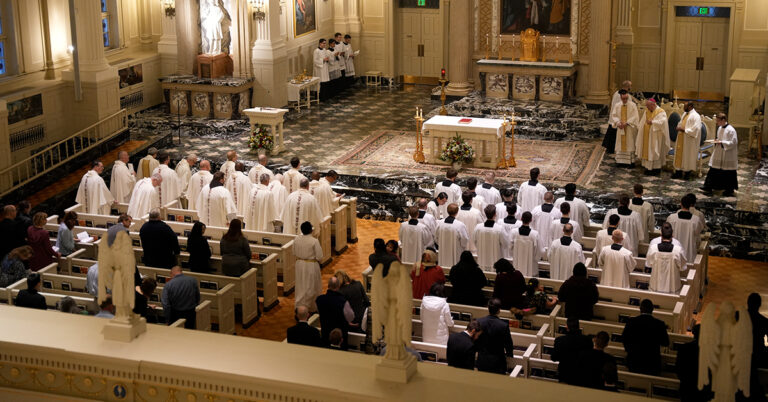
On January 23, Bishop Michael McGovern from the Diocese of Belleville presided over the Acolyte Installation Mass, an annual ceremony for individuals aspiring to the…

Pope Francis has appointed Mons. Anselm Pendo Lawani as Bishop for the Catholic Diocese of Ilorin in Nigeria. Bishop Lawani was ordained on August 15, 2000…
After a long journey with meditation on the Footsteps of Saint Paul, going from Turkey, through Greece and ending up in Rome, I felt very low, tired, and empty. Deep in my heart I asked myself, “Perhaps God is asking me to go on a silent retreat!” And this is exactly happened when we arrived in Assisi. The retreat allowed me, together with my fellow seminarians, to set apart time for God by disconnecting from the very connected world. Going away to be alone with God was a beautiful experience.
The seminarians were on a week-long silent retreat in Assisi, home to St. Francis, to prepare for the transitional diaconate ordination this summer. Assisi is a hilly city that can be explored on foot, and one will find stunning churches within a one-mile radius. The Basilica of St. Francis is one of the most famous churches in Assisi, and the saint’s tomb is located on the lower basilica of the property.
We have just concluded our time in Rome with an audience from Pope Francis at the Vatican. This marked my third return to St. Peter’s in Rome. What has always surprised me about St. Peter’s is how remarkably well kept it is. The façade is clean and crisp, the colonnade stands tall and strong, adorned with statues of the early saints. Granted it underwent renovations during the Renaissance, but the point still stands.
We had just covered roughly 2,200 miles by bus across Turkey, but when we arrived in Greece it was this simple yet thoughtful question from a classmate that got me refocused on the Marian aspect of our pilgrimage. None of us could come up with a definitive answer, but in a sense the beauty of the mystery has helped me engage with our pilgrimage more.
Today was an amazing day. We started with Lauds before heading out to the Holy Steps. These Steps were the steps Jesus ascended during his Passion when he was judged by Pontius Pilate, and they were moved from Jerusalem to Rome by St. Helena in the 4th Century.
We have just concluded our time in Athens, Greece and recently arrived in Rome. The final monument we visited in Athens before we departed was the Tomb of the Unknown Soldier, a memorial honoring all of the Greek soldiers who died in service to their country. It is guarded 24/7 by two Evzones, specially trained and handpicked soldiers of the Presidential Guard of the Greek Armed Forces.
It’s our last full day in Greece, and the day when we celebrate the Solemnity of the Immaculate Conception. Today we toured the city of Athens, hiked up to the Parthenon (an ancient temple dedicated to the goddess Athena) and visited the Areopagus on the same rocky outcrop, where St. Paul preached to the Athenians (see Acts 17:16-34).
Why am I such a pessimist? There can be so much good circling around me everywhere, and I choose to focus on the bad. It’s very clear to me that Saint Paul was far from being a pessimist. My fellow seminarians and I are going through Acts of the Apostles with Fr. Kasule, reading about all the sites to which Saint Paul traveled.
One of the things that has struck me the most on this pilgrimage so far is the intimacy the Christian community shared together during the early Church. It first occurred to me at the cave churches in Cappadocia while pondering the friendship of Basil and Gregory of Nazianzus and the tight knit communities and homes that the believers would have shared.
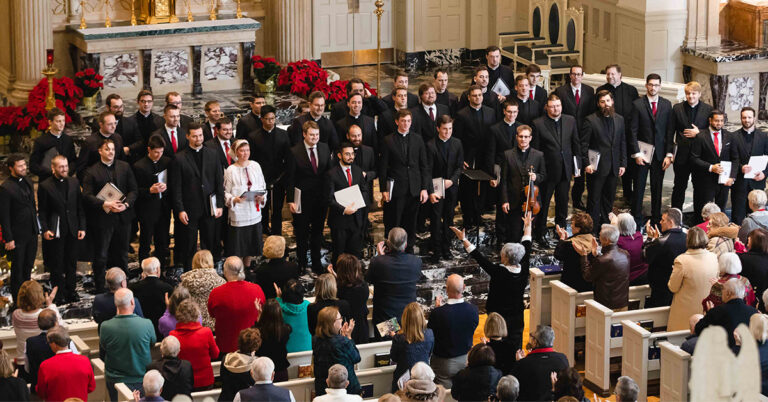
On Sunday, December 3rd, the halls of the Mundelein Seminary at the University of Saint Mary of the Lake echoed with the enchanting melodies of…
A good piece of advice that I learned from my friends who love to travel around the world is this phrase “travel light.” What is it exactly to travel light when you are going on a journey? What does it mean in our case going to a pilgrimage following the footsteps of St. Paul?
Ayer continuamos nuestra peregrinación por la costa occidental de Turquía, contemplando la belleza del mar Egeo desde lo alto de la ciudad de Assos y concluyendo nuestro recorrido del día en la antigua ciudad de Troas. Fue desde Troas desde donde San Pablo zarpó para continuar su viaje hacia Europa, llevando la buena nueva de Jesucristo a Occidente.
La antigua ciudad de Éfeso fue un importante centro del mundo romano. Era una ciudad portuaria con una población cercana a los 250 000 habitantes. Las calles de la ciudad estaban hechas de mármol y contaba con una biblioteca que solo era superada por la gran biblioteca de Alejandría. En la ciudad había muchos templos dedicados a los dioses romanos, especialmente a la diosa Artemisa, cuyo nombre se repitió durante dos horas en el teatro cuando Pablo intentó proclamar el evangelio en Éfeso.